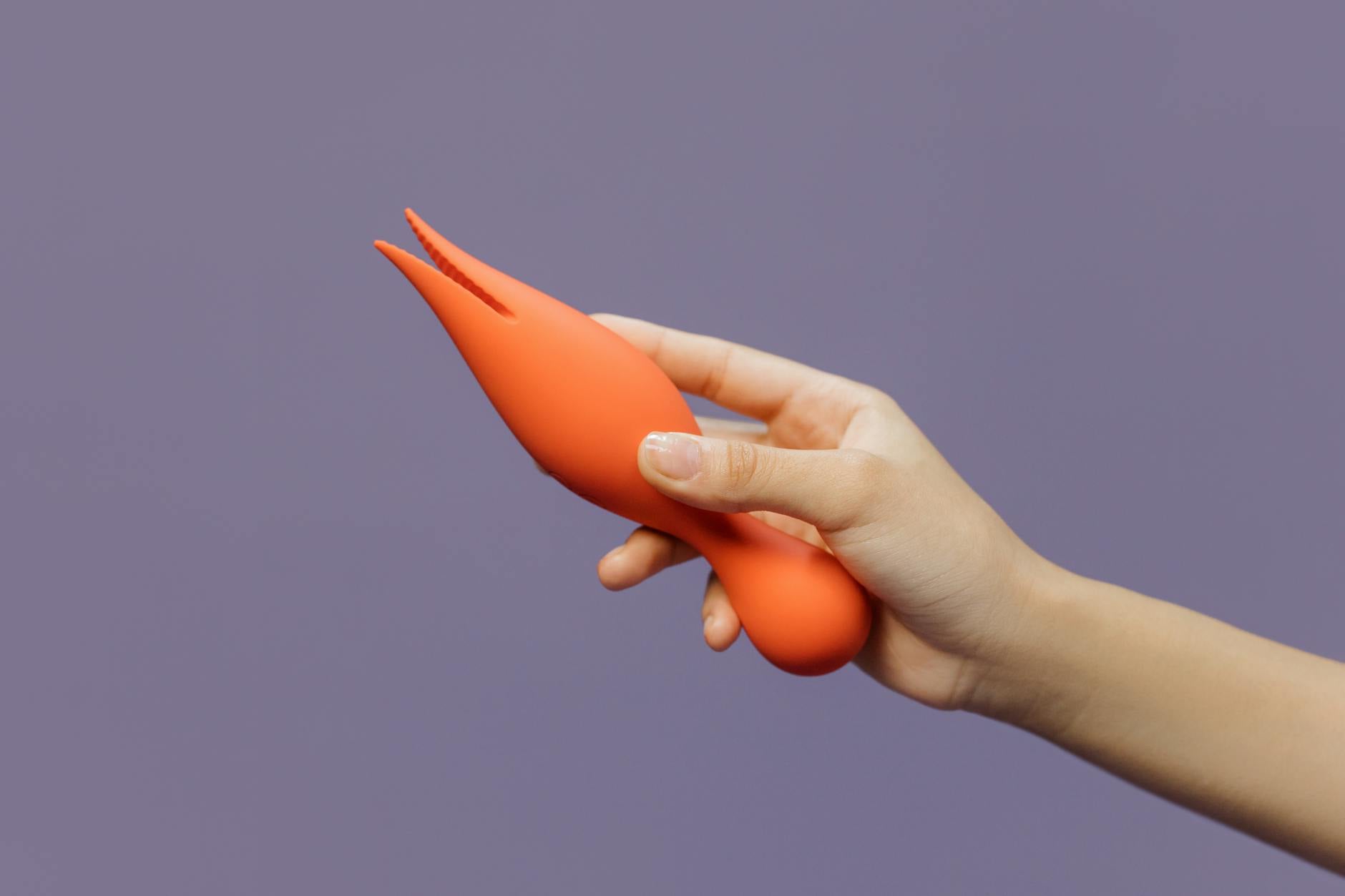
Here's the thing about coming with your partner watching
It's not actually about your body. Your clitoris works the same way solo as it does partnered. Your nerve endings don't suddenly forget how to fire. But your brain? Your brain does a complete shift. You go from relaxed and curious to hyperaware. You're monitoring their face. You're wondering if this is taking too long. You're performing satisfaction instead of feeling it. And then, nothing.
This is one of the most common friction points couples face. Not because anyone's doing anything wrong, but because pleasure requires a specific mental state, and performance pressure destroys it.
Why the pressure hits different when someone's watching
When you're alone with a lemon vibrator, your nervous system can downshift. You're in charge. If something feels amazing, you can linger. If you need to switch rhythm, you adjust. There's no timeline. But the moment a partner is present, you've added a spectator. Even if they're loving and patient, your brain registers it as an audience.
There's actual neuroscience here. Your prefrontal cortex, the part that handles executive function and self-monitoring, activates more intensely. Meanwhile, your limbic system, which generates pleasure and arousal, quiets down. You're stuck in your head analyzing instead of in your body experiencing.
Add in cultural messaging about female orgasms being rare or difficult, and you're already behind. Add in relationship history, body image stuff, or past sexual experiences, and the weight gets heavier. Your partner wants to see you feel good. You want them to see you feel good. But that wanting becomes the barrier.
What lemon clitoral vibrators actually change about this dynamic
Lemon vibrators work on a different principle than your hand or your partner's touch. Air-suction technology doesn't require the same kind of direct pressure or consistent rhythm. You can relax more. Your body can respond more naturally because the stimulation is gentler and more dispersed, which means your nervous system doesn't have to brace.
But the real shift is psychological. When you introduce a toy, you're making a statement: "This isn't about you or me performing. This is about my pleasure, and I'm taking an active role in it." That framing alone changes the energy. Your partner becomes a collaborator instead of a judge.
You're also giving yourself permission to look inward. Using a lemon sucker or other clitoral vibrator gives you something to focus on that isn't their face. You can close your eyes. You can concentrate on sensation instead of surveillance. That mental permission is doing half the work.
The practical setup that actually works
Start by using your lemon vibrator solo, without any timeline pressure. Get familiar with what patterns feel good, what intensity works, how long your warm-up typically takes. This isn't about becoming an expert. It's about knowing your own baseline so you're not discovering it for the first time with your partner present.
When you're ready to bring your partner in, talk about it first. Not sexy talk, just practical talk. Say something like: "I want to use my vibrator while we're together. I'm not sure how this will feel yet, so I might need to focus inward for a bit." That sets an expectation. They're not watching you fail to come. They're watching you explore your pleasure.
Start with your partner close but not necessarily touching. They can be inside you, or next to you, or just present in the room. Let your body decide what feels good. If you want them to touch you at some point, say so. If you need them to stay still while you focus on the lemon vibrator, that's equally valid.
Keep your eyes open or closed depending on what serves your pleasure. If eye contact feels grounding, do it. If it feels distracting, don't. This is your sensory experience, and you get to design it.
The rhythm pattern that helps most couples
Most lemon clitoral vibrators have multiple settings. Start low and let your body build. Don't jump to intensity three if intensity one is doing the work. Your nervous system needs a ramp, not a jolt. When you feel yourself approaching climax, resist the urge to communicate about it out loud. Internal focus is your friend here.
Many people find that switching patterns right as they're getting close actually helps, not hurts. It resets the sensation, keeps your body from plateauing, and often pushes you over the edge. Experiment with this solo first so your partner knows what's normal.
If you're partnered with someone, they can help by staying present without adding stimulation. Sometimes the simplest thing is their hand on your chest or their breath on your neck. That grounding touch can be the difference between scattered and focused.
Why your clitoris might respond differently this time
If you haven't come with a partner present before, your first attempt with a lemon vibrator might not end in orgasm either. That's not failure. That's your nervous system learning that this situation is safe. Pleasure isn't a destination. Each time you practice relaxing into it, your body gets incrementally better at shifting out of performance mode.
Some people take three times. Some take fifteen. There's no normal. What matters is that you're removing shame from the process. Coming with a partner present isn't a test. It's a skill your nervous system learns through repetition and safety.
If you find yourself getting close and then losing it, that's usually anxiety spiking. Your brain is saying, "Wait, are we really doing this?" Instead of fighting that feeling, name it. Say to your partner: "I'm in my head. Give me a second." Then refocus on pure sensation. What does the vibration feel like right now? Where in your body do you feel it most? That sensory anchor often pulls you back.
When to involve your partner more actively
Once you've had success using a lemon vibrator with your partner present, you can experiment with them becoming more involved. They might hold the vibrator while you guide the pressure and rhythm. They might use it on you while you stay still. They might alternate between the toy and their touch.
Each variation teaches your nervous system something different. Your brain starts to associate their presence with pleasure instead of pressure. That's the real win. That's the shift that makes future partnered sex feel less performative and more intimate.
Some people find that this reframing actually increases desire. When you're no longer performing, when you're genuinely pursuing your own pleasure, your partner often finds that magnetic. There's something about authentic desire that's way more attractive than faked satisfaction.
The conversation that matters before you start
Tell your partner what you need. "I want to try this, and I might be quiet or still while I focus." "I might need you to back off if I get overwhelmed." "I might not come this time, and that's okay." Give them permission to ask questions too. "What can I do?" "Should I touch you?" "Is this working?" Take those questions seriously. They're asking because they care.
If your partner has shame around toys, explore that separately. This isn't about convincing them. It's about understanding what's underneath their hesitation. Often it's insecurity, not rejection. Sometimes it's past experience. Sometimes it's just habit. Once you know what's driving it, you can address it directly.
Why this actually deepens intimacy
Using a lemon clitoral vibrator with your partner present is an act of trust. You're showing them what you need. You're modeling pleasure instead of people-pleasing. You're saying: "My body matters. My sensation matters. And I want you here while I experience it."
That's intimacy. Not the fantasy version where everything aligns perfectly. The real version, where you're vulnerable and specific and willing to ask for what you need. Your partner gets to see you in genuine pleasure, not performing it. That's worth far more than any silent orgasm achieved through self-erasure.
Common questions couples ask about this
Will using a vibrator make my partner feel replaced?
Not if you frame it clearly. A vibrator isn't competition. It's an access point. You're saying: "I want more pleasure, and this helps me get there. I also want you here." That's not replacement. That's expansion. Most partners feel genuinely relieved when the pressure to be the sole source of your pleasure lifts.
What if I still can't come even with the vibrator?
Then you're not broken. You might need more time. You might need less focus on orgasm as the goal and more focus on sensation. You might benefit from talking to a sex therapist who specializes in this. Many people find that once the orgasm expectation is removed, orgasms actually happen more easily. Counterintuitive, but true.
How long should we expect this to take?
Anywhere from five minutes to twenty. If you're regularly going past twenty-five and not feeling close, dial back the intensity. Your body might respond better to a longer, gentler build than an aggressive approach. There's no prize for speed here.
Is it okay if my partner uses the lemon vibrator on me instead of me using it?
Absolutely. Some people find that letting go completely and letting their partner control the toy is the permission slip they need to relax. Others find it creates performance pressure all over again. You'll know which one you are after the first try.
What if my partner wants to use it during penetration?
That's a beautiful option. Penetration plus clitoral stimulation is often the most reliable route to orgasm during partnered sex. The lemon vibrator lets you get that dual sensation without your partner having to coordinate their hand and body at the same time. Everyone wins.
Should we set a time limit?
Not on the first few tries. Your nervous system needs to know there's no deadline. Once you've had success, you can play with rhythm and pacing. But early on, open-ended is better. You're building a new neural pathway here, and that takes space.
The shift that happens after
Most couples find that using a lemon vibrator together changes how they think about pleasure overall. It removes the mystery. It normalizes asking for what you need. And it usually means better orgasms, more frequently, with less anxiety in between.
You're not fixing anything broken. You're removing the barriers to what your body already knows how to do. Your clitoris, your nerve endings, your capacity for pleasure? All still there. You're just giving yourself permission to access it without shame, without performance, without the exhausting work of staying present while pretending nothing's happening.
That's the whole game right there.
FAQ
How soon after starting should we expect results?
Some people have success the first time. Many take three to five attempts before their nervous system fully trusts the situation. This isn't a problem. Each time you practice, you're building new neural pathways that associate your partner's presence with relaxation instead of surveillance.
Can we use a lemon clitoral vibrator if we're just starting to have partnered sex?
Completely. In fact, many people find that starting with a vibrator present from the beginning sets a different baseline. You're not trying to unlearn old patterns. You're establishing new ones from the start.
What if one partner wants to use toys and the other doesn't?
Start by understanding why. If your partner isn't interested in toys, there's usually something underneath that hesitation. Work with that first before pushing the vibrator agenda.
Is there a difference between using a lemon vibrator and other adult toys for this?
Lemon vibrators and clitoral suckers tend to work faster because they don't require the same level of direct pressure. That means less performance strain on your body and more ability to relax. Other toys absolutely work too, but air-suction technology has a particular advantage for nervous system regulation.
What if my clitoris feels too sensitive when my partner is present?
That's usually anxiety manifesting as physical sensation. Your nervous system is protecting you. Start with the lowest intensity and longest warm-up time. Sometimes just having your partner's hand on your chest while you focus on breathing helps settle that hypersensitivity.
Should we talk about what happens if it doesn't work?
Absolutely. Agree in advance that not coming doesn't mean failure. You're practicing pleasure, not passing a test. The goal is presence and sensation, not a specific outcome. Once that pressure lifts, outcomes usually improve anyway.
Ready to explore this with your partner? The conversation starts before the vibrator does. Be honest about what you need, what makes you nervous, and what you're hoping for. That vulnerability is where real intimacy begins. Need more support navigating this with your partner? Reach out and let's talk.